Girlboss
There is a great scene early in “Girlboss” where the protagonist (Sophia) buys a third hand leather jacket. The shop owner agrees to sell it to her for $9 and then Sophia reveals that she can resell it for $600. We are not told what the shop owner paid for the jacket, but let’s say it was $6 (almost certainly it was less than $9).
What is the jacket worth? We know the price was $9, but is it actually worth $6, $9, or $600?
We infer that the seller has made a profit on the jacket, so they were content with the transaction until Sophia rubbed their nose in their ignorance of its possible resale value. Could the seller have realised more than $9 on the jacket? Yes, but at the cost of having to research in detail the potential resale value of every item which passes through their hands. Maybe the cost of that would outweigh the occasional $591 payday. Sophia brings her prior expertise to the transaction, and is thus able to make a great profit out of the deal, because she knows where she can resell it. 1
On Value
We can see that value is subjective. I differentiate price from value, where price is the amount paid in a specific transaction, and value is the subjective benefit to each participant after the transaction is complete.
In this conception, value is similar to a broad understanding of utility (beyond mere economic self-interest). This notion of utility is incommensurable between individuals, and variable across time, location and circumstance, even for the same person. It is also affected by the weather, and the projected mind state of other people involved in potential transactions. It includes internal psychological factors of the person: how do I feel about this right now; how will I feel if I make a transaction? Due to its consequent unmeasurability, value for an individual cannot be reduced to a single number (not cardinal), but can often be assessed by ordinal comparisons. (Attempting to derive a utility function is an enticing but ultimately fruitless exercise, as the set of relevant variables is not finite.)
Some services and experiences are highly valued even though they are rarely priced in money: parenting, care for older relatives, time spent with friends and lovers, household chores, social kudos. Lack of quantitative pricing may make such value opaque to conventional economic analysis, but it is wealth in these areas which underlies the strongest ambitions of most people. These social sources and stores of value are foundational and relational. They transcend any notion of market trading. We only resort to quantitatively-measured trading when we need something from strangers.
Because different people will value the same thing differently, even at the same time and location, it is not possible to assign a general value to any object or service which is unrelated to the value assigned by specific individuals. Notably, the price paid for an object does not show the value of the object, but is rather a lower bound for the value of the object for the buyer as compared to that amount of money. Conversely it is an upper bound for the value of the object to the seller as compared to that amount of money.
One might log all transactions for a specific commodity (during some specified period and circumstance), and then calculate an average of the prices paid for the commodity. Such a figure might give a general idea of the value of the commodity, as expressed in money, sufficient for some forward planning purposes.
We might also note that for many commodities, the possibility of resale exists, so that part of the criteria for valuing some commodities is the potential resale value. This effect might drag outlying valuations closer to the average valuation.
The Labour Theory of Value
Writing before the industrial revolution, when almost everything was hand-made, Adam Smith settled on the quantity of labour embodied in a commodity, as being the ultimate determinant of its value (thus allowing the value of commodities to determined separately from any variability in the value of money). Prior to the advent of industrial machines and large corporations, that may have been a reasonable theory, and Ricardo followed that lead. 2
By the time Marx was writing (1840’s onward), he was using the same idea to justify his political theory that the industrial owners were taking more than their fair share of the profits of their enterprises: once it is asserted that it is only labour which gives value to a produced commodity, then it seems self-evident that it should be the labourers who get given all of the difference between the sale price of the commodity and the cost of the input materials. In this analysis, it is deemed exploitative that the owners who retain most of that difference, after having paid the labourers their wages.
However, in the post industrial revolution era when Marx was writing, it was no longer the case that the only added value in a finished product, was the human labour which had gone into it. In the context of a factory or mill employing industrial machines and hundreds of workers, the owner of the enterprise contributes their intellectual property and brand name, their specific technical innovations and productivity increases, and their relationships with the broader market of suppliers and distributors and retailers. Investors in the enterprise risk their capital: perhaps sharing in the profits, or perhaps losing everything.
It is the owner of the manufacturing enterprise who has created the context in which the value of the finished product can be more than the value of the labourer’s work, and the owner is rightly rewarded for creating and maintaining that context. Only the enterprise has any way to make that additional value real, and accessible to anyone (either owners or workers).
However, I do concede that the wages of the labourers will frequently be less than the value of their work to their employer. In any situation of over-supply of labour, the market price of wages will become depressed, without any alteration in the value of the completed product. And this is very likely the scenario that Marx saw, as the land workers and artisans got displaced into the cities by technology improvements in their prior livelihoods. Faced with an over-supply of unskilled labour, the factory owners were able to drive down wages by employing those most desperate to work.
However, from the perspective of each worker, trading their labour time for their wages was still a net increase in value to the worker: even if it was just the ability to buy something instead of nothing.
We might note that this situation is far less likely to apply to skilled labour, where the supply is likely to be more constrained; thus skilled workers are usually able to command a wage closer or equivalent to a true market value.
So in a partial sense, Marx was correct to state that what the unskilled worker gets paid for their labour is less than the value which the business acquires from that labour. However, as already noted, he was wrong to state that all of the profit of the enterprise should be allocated to the workers.
Hunting for Surplus Value
Let’s drill a little deeper into the value of the labour of a particular worker. For the later examples, we can imagine some kind of production line factory where there are lots of machines and lots of workers. Somehow we allocate pro-rata the sales of the factory across each the workers. Some of the workers may be more essential than others, and we will assume that has been taken care of, in how the pro-rata allocation of sales was done. In each example, the values are listed in descending order.
Example 1 : pre-industrial craft (Adam Smith era)
S : Sale value of this craft
T : Take home pay of the crafter
These values are likely to be almost identical, validating the pre-industrial labour theory of value
Example 2 : industrial factory (Karl Marx thesis)
Value of the output of a specific worker, from the perspective of the enterprise:
S: Pro-rata output sale value of the work of this specific worker
C: Pro-rata output sale value of the work of this specific worker, less cost of materials, site, machinery
T: Take home wage of worker
In this example, the difference between S and C is the capital value transferred to the product, and the difference between C and T is the surplus value according to a Marxist analysis. Marx notes that the owners get paid the difference between S and T, and he asserts that the workers should be paid C instead of T.
Example 3 : industrial factory (revised thesis)
Value of the output of a specific worker, from the perspective of the enterprise:
S: Pro-rata output sale value of the work of this specific worker
C: Pro-rata output sale value of the work of this specific worker, less cost of materials, site, machinery
V: Value to enterprise of the worker
T: Take home wage of worker
In the specific context of the enterprise the owner may be able to value the labour of the worker at more than what they pay them (V>T). There is a upper limit on justifiable wages, where the pay and value of the worker are equal (V=T), but finding that equilibrium is problematic in that the value of the worker is volatile, because it is at least partially dependent on current sales levels, and evolving worker skill. The owner is unlikely to pay the worker more than the value of their labour (T>V) except perhaps for short periods like during slow sales or training. Over the course of the employment the value of the worker needs to be at least as high as the wages (V>=T), otherwise the owner of the enterprise has no incentive to employ the worker. But it is clearly a valid incentive of the workers (perhaps with the assistance of a union) to negotiate their wages (T) towards the value of their labour to the enterprise (V). I regard this gap between V and T as the legitimate definition of surplus value.
In this analysis the gap between C and V is the additional value which the enterprise creates by its existence, and which cannot exist without the enterprise. It includes factors like brand reputation, intellectual property, manufacturing innovation, relationships with suppliers / distributors / retailers, and the identification / creation of customer demand. The owners of the enterprise create this value by creating and maintaining the enterprise. Thus this value correctly accrues to the shareholders of the enterprise, and can be termed shareholder value.
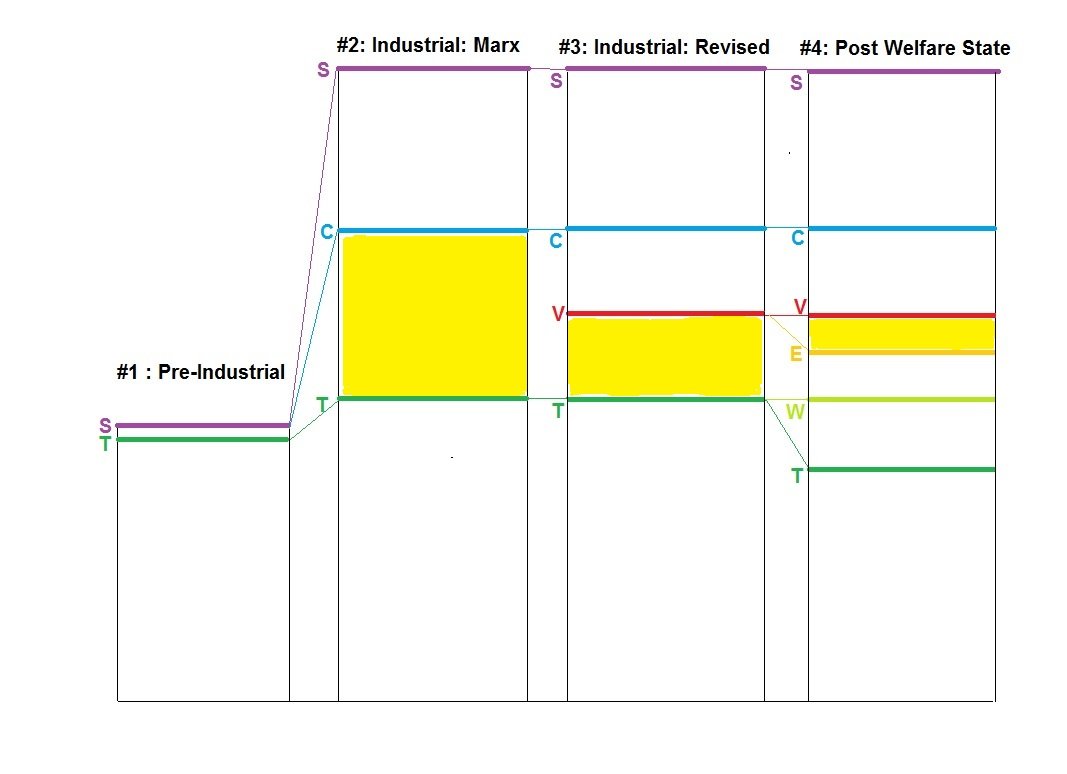
Example 4 : industrial factory (post welfare state)
Value of the output of a specific worker, from the perspective of the enterprise:
S: Pro-rata output sale value of the work of this specific worker
C: Pro-rata output sale value of the work of this specific worker, less cost of materials, site, machinery
V: Value to enterprise of the worker
E: Enterprise cost to Employ worker (incl employer NI tax, employer pension contribution, workspace, HR, recruitment)
W: Wages to Worker, before income tax and employee NI (gross pay)
T: Take home wage of worker (net pay)
In the era when Marx was writing, there was no welfare state, no National Insurance(NI), no pension contributions and income tax did not kick in until much higher levels of income than the wages of factory workers. So the modern configuration of worker value and wages has changed again.
The enterprise cost to employ someone (E) is larger than just what the employee gets paid (something like 25% to 40%more{link} in a UK context. So the employer needs that all-in employment cost to be equal or lower to the value of the work of the employee (V>E and E>W x 1.25).
Similarly, the UK 0% income tax band (“Personal Allowance”) ends well before the salary of a full time minimum wage job, so even unskilled workers are now paying Income Tax and employee National Insurance (something like 13%), so W>T x 1.13)
Taken together, at least a quarter of what an enterprise is expending to employ a UK minimum wage worker full time, is being extracted by the state. For employees on higher wages, that percentage gets even higher. Maybe some of that extracted money gets back to the worker via the NHS and free schooling, etc, but the complexity of taxation and benefits, along with the opacity of government spending makes such an linkage murky at best.
In consequence, Marxist claims on behalf of workers, to all of the gap between C and T, could at most be legitimate for only 75% of that gap. As noted above, I regard workers as having no claim on shareholder value, and therefore workers can legitimately aspire to at most 75% of the gap between V and T.
RJ7: Sept 2026
- Auctions work on the same principle of values being different across individuals. The winner of the auction is the person who values the object most highly, and they pay the value of the second most high. ↩︎
- Even in Adam Smith’s time, it should have been clear that labour was not the only factor involved in sale value. The owner of a windmill or watermill could produce flour from grain far more efficiently than a hand mill ever could. Is the value of flour to be calculated based on cost of hand-milling, water-milling or wind-milling? Is it not also dependent on whether there is a river (watermill, since 250BC) or a hilltop (windmill, since 1000AD)? ↩︎